Why This Matters
International students get told two things after graduation: get a job, or go home. No one tells them option three: start a company. This article walks through the 36-month window, what to do each phase, and the 3 mistakes that cost founders their visa.
The Real Constraint Isn't Legal, It's Timing
OPT gives you 12 months of work authorization after graduation. STEM OPT adds another 24 months on top if your degree qualifies. That is 36 months total. Three years to build something real.
Most international students waste the first 6 being cautious. They job hunt, they wait for sponsorship, they assume the founder path requires some special permission they do not have.
The visa framework already supports founders. You can be a founder on OPT. You can be a founder on STEM OPT. The problem is not the law. The problem is that nobody hands you a playbook.
Pull Quote
“OPT isn't a waiting room. It's 36 months to build something that can sponsor you.”
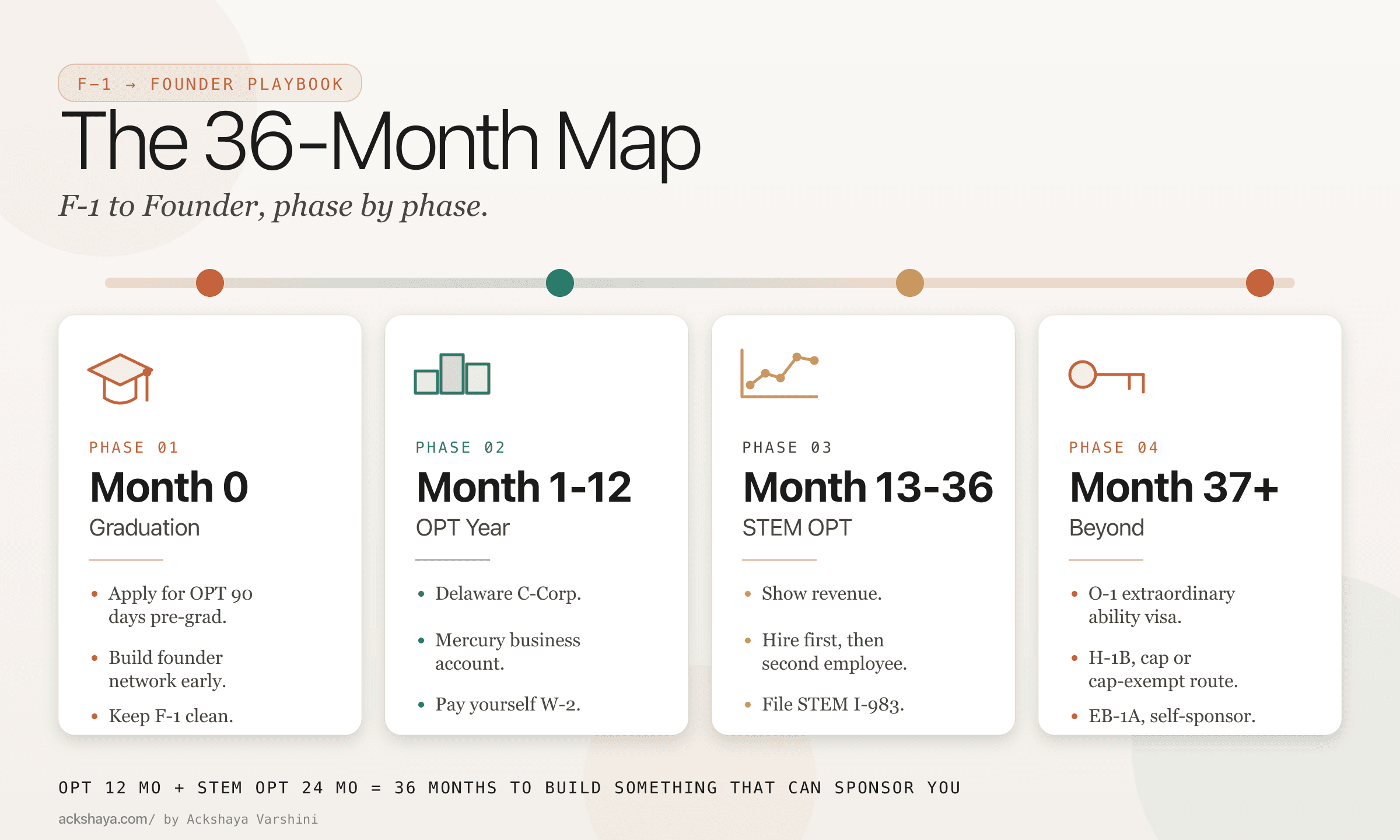
The 36-Month Map
Four phases. Each phase has a job to do. Miss one and the next one gets harder.
- Apply for OPT 90 days before graduation.
- Line up founder friends and advisors.
- Keep F-1 status clean. No gaps.
- Incorporate a Delaware C-Corp.
- Open Mercury, run yourself on W-2.
- Paper trail the founder role from day one.
- Demonstrate revenue and customer contracts.
- Hire your first, then second, employee.
- Document a management role, file I-983.
- O-1 for extraordinary ability.
- H-1B via cap or cap-exempt route.
- EB-1A petition. Sponsor yourself.
The 4 Checkpoints
Hit these in order. If you miss one, fix it before moving on.
- 1.EAD card physically in hand before your first day working as a founder.
- 2.Delaware incorporation plus a business bank account within 30 days of OPT start.
- 3.Paying yourself a W-2 salary (even $1K a month counts) by month 3.
- 4.An immigration lawyer who has worked with international founders specifically, not a generalist.
The 3 Traps That Cost Founders Their Visa
Trap 1 · Unpaid Founder
Working on your company without a salary is not valid OPT employment. USCIS counts days of unauthorized work, not hours of passion. If you are not on payroll, you are not legally working. That burns OPT days you cannot get back.
Trap 2 · No Paper Trail
If USCIS audits your STEM OPT, they want proof. W-2s. An employment offer letter you signed with your own company. A job description. Hours worked per week. Training plan on Form I-983. A shoebox of Stripe receipts is not a paper trail.
Trap 3 · Wrong Lawyer
A generalist immigration lawyer will tell you to get a job and wait for H-1B. That is not legal advice, that is risk aversion. Find a lawyer who has moved F-1 founders through OPT, STEM OPT, and O-1 or EB-1A. The difference shows up in how your filings are structured.
The 3 Questions to Ask Your Lawyer
You learn more from these three questions than from an hour of general consultation.
- 1.“Have you moved an F-1 founder from OPT to STEM OPT while they were running their own company?”
- 2.“What does my W-2, board role, and equity split need to look like for a clean E-2, O-1, or EB-1A path?”
- 3.“At what point would you recommend switching to O-1, versus waiting to file EB-1A directly?”
What I'm Doing Next
Most international students who try the founder path figure it out alone. Too many stop because they could not find anyone who had done it and was willing to answer their specific questions.
I am working on Alma to fix that. It matches international students to mentors who have walked this exact path. Not general career coaches. Founders who built a company on OPT, moved to STEM OPT, and ended up on O-1 or EB-1A. If that is the path you are on, reach out.
Resource Links
USCIS OPT (Optional Practical Training)
OfficialUSCIS STEM OPT Extension
OfficialBeyond Border
Founder LawyerStripe Atlas
IncorporationMercury
IncorporationAlma (joinalma.ai)
Mentor MatchIf this helped, follow on LinkedIn for the next piece. I post 3x a week on solo-founder builds, international-student tactics, and mech eng to AI.
Follow on LinkedInMore resources coming soon
← Back to all resources